Black House Spiders - All you need to know!

Last Updated: May 6, 2026
Gordon Reidy
spider control, Spider information

The black house spider, Badumna insignis, is one of the more common spiders found around Australian homes. Although their bite is quite painful, the main concern for homeowners is that they build unsightly, dense webs around windows, doors and eaves. Fortunately, this makes it very easy for the homeowner to carry out their own pest control treatment.

Black house spider
Black house spider, Badumna insignis

Black house spider bite symptoms

Black house spiders are actually quite timid and will often retreat into their web when disturbed. However, their bite can be quite painful and cause local swelling around the bite area. Nausea, vomiting and sweating has been recorded in a few cases. Although their webs have a funnel-web appearance, it’s important not to confuse the black house spider with a funnel web spider, as the treatment is different. Following a black house spider bite you should follow the standard spider bite first aid, rather than applying snake bite first aid which is required to deal with a funnel web spider bite.

Standard spider bite first aid:

  1. The patient should sit down and try to relax
  2. Clean the bite with water and disinfectant
  3. Apply an ice pack to the bite area
  4. If possible, collect the spider or take a picture for identification (if medical treatment is required)
  5. If symptoms worsen seek medical attention

If you are unsure about spider identification, treat the bite as per a funnel-web spider or snake bite, and seek medical attention.

Medical Disclaimer: While we make every effort to make sure the information in this website is accurate and informative, the information does not take the place of professional or medical advice.

Black House Spider Identification

Black house spider
Black house spider web

Black house spiders are a charcoal / black colour, although the abdomen appears grey (sometimes brownish) with white markings. Their legs can be brown and black. Females can have a body of up to 18 mm long with a leg span of 30 mm. Males are noticeably smaller and slimmer. Their dense, obvious webs are a key identifying feature, if the spider cannot be located.

Black house spiders are sometimes confused with funnel-webs spiders, mainly due to their funnel-shaped web, but it is quite easy to tell the difference.

Black house spider:

  • Generally lives above ground level and builds webs above ground (under eaves, around windows)
  • Builds obvious, dense funnel shaped webs
  • Body up to 18 mm, leg span up to 30 mm
  • Mottled abdomen, brown legs
  • Small jaws

Funnel-web spiders:

  • Lives on or below ground (apart from less common tree-dwelling species
  • Builds partially hidden webs around their burrows in the ground (in tree holes for tree-dwelling species)
  • Larger than black house spider (body up to 50 mm, leg span up to 100 mm)
  • Uniform black colour – shiney carapace, dull abdomen
  • Massive jaws

In their natural environment, black house spiders build their webs on tree trunks, logs and under rocks – any place where there is a crevice to hide. Around buildings, they build their webs around window and door frames, in vents and under eaves.

Black house spiders build dense webs, often with a funnel-like shape which leads to their hiding place. Their webs are not actually sticky but make up of a dense network of silk, which is designed to snag the spiny legs of insects.

Female spiders will never leave their web unless they are forced to, and will keep on adding layers of silk, making the web denser over time.
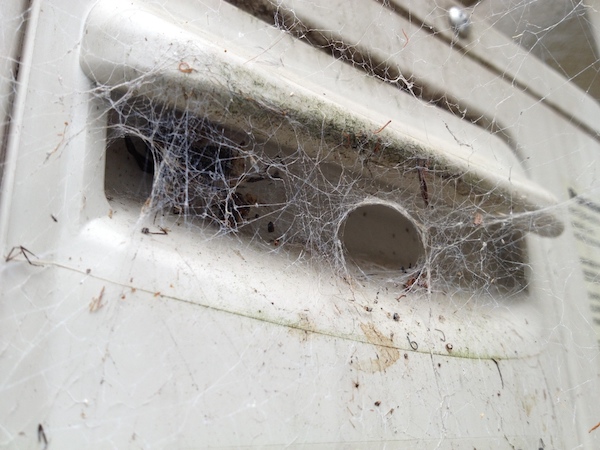
In their natural environment, black house spiders build their webs on tree trunks, logs and under rocks – any place where there is a crevice to hide. Around buildings, they build their webs around window and door frames, in vents and under eaves.

Black house spider
Black house spider
Funnel web spider
Funnel web spider

Black House Spider Lifecycle

Spiderlings moult as they grow. According to the Australian museum they mature during the warmer months (having grown on plentiful prey) and live for about 2 years.

Black house spiders feed predominately on insects (both crawling and flying), which get caught in their dense, stick webs. They will often build their webs on houses near sources of artificial light, which attracts flying insects.

Males leave their webs to find females and will pluck strands on the female’s web to make sure she is receptive to mating. The males will often remain with the female for several days and mate several times – they are not consumed after mating as is often the case with redback spiders!

Black house spiders are one of the favourite prey items of white-tailed spiders. So, carrying out a treatment for black house spiders will make your property less attractive to white-tail spiders due to the lack of food.

Black House Spider Australia – FAQ

People ask whether black house spiders are poisonous, but what they really mean is, are they venomous? (Poison = something injested, inhaled or absorbed through skin, venom = something injected).

Black house spider bites are moderately venomous, although there is no need for an anti-venom. The standard spider bite treatment is generally all that’s required, although seek medical attention if concerns or unsure about spider identification.

Although black house spiders are moderately venomous, they are not considered particularly dangerous, as bites are not that common because they are quite a timid spider. When disturbed they typically retreat quickly into their hiding place. They will generally only bite if picked up (intentionally or by accident).

Black house spider bites are moderately venomous, in that the can cause pain with swelling around the bite. Sometimes they can cause sweating, nausea and dizziness.

A general insecticide spray around the perimeter of the home, particularly around windows and doors, under eaves and in vents, will prevent black house spiders building their webs for many months.

If you already have black house spiders living around the outside of your home, make sure you spray the webs and into their hiding places. Leave the webs in place for at least 24 hours before brushing down the webs. Don’t wash the webs down with a hose, as it will also wash the insecticide away.

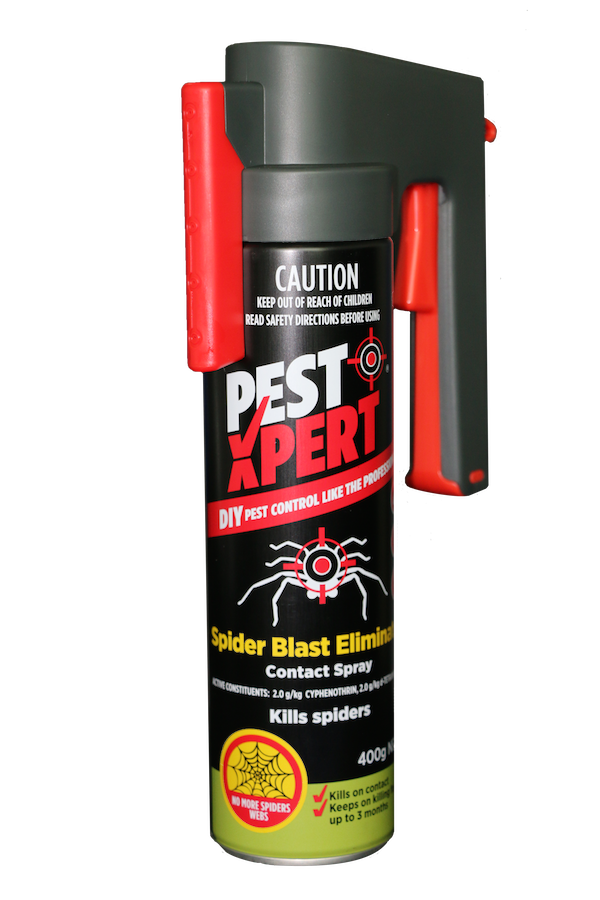
To get rid of black house spiders in the house, best to spray it directly and coat the web with PestXpert Pro-Spray Spider Blast. Once the spider has died, simply brusg the web away.

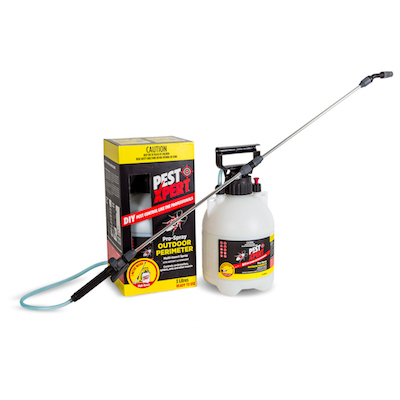
PestXpert Pro-Spray Outdoor Perimeter is the idea product for whole of house treatment, although PestXpert Pro-Spray Spider Blast is a great option for spot treatment.
More information on spider pest control

Originally Published: November 11, 2023
author bio image

Author:

Gordon Reidy has over 30 years experience in Pest Control Product Development and Product Safety. As the lead formulator at PestXpert, he has helped develop some of Australia’s most trusted household pest solutions. With a PhD in Toxicology, Gordon is passionate about delivering effective, science-backed products that are safe for families and the environment.

Share This Post

Further Reading

  • white tail spider
    White Tail Spiders – All You Need to Know!

    Everything you need to know about white tail spiders: What do they look like? Where do they live? Information on white tail spider bites - is the flesh eating spider bite a myth? How to get rid of white tail…

  • Funnel web spider
    Funnel-Web Spiders - All you need to know

    Everything you need to know about redback spiders: What do they look like? Where do they live? Information on redback spider bites? How to get rid of redbacks? And more…

  • huntsman spider
    Huntsman spiders – Everything you need to know

    Everything you need to know about hunstman spiders: What do they look like? Where do they live? Information on huntman spider bites? How to get rid of huntsman? And more…

  • female redback spider
    Redback Spiders - All you need to know...

    Everything you need to know about redback spiders: What do they look like? Where do they live? Information on redback spider bites? How to get rid of redbacks? And more…